The origins of the Clans: World-building in Warrior Cats
BY VICKY HOLMES
How the Clans began
One of the best things about Warriors is seeing how many of you have been inspired to write your own Clan-themed fiction. You don’t need any special skills or equipment to conjure up your own stories and characters. I love knowing that you too have experienced the freedom and excitement that comes from diving into a world that exists in pure imagination, shaped by your unique experience and outlook. When story-writing is going well, it is like swimming in a warm sea, surrounded by colourful fish that nip and dart in unexpected directions. Sometimes I chase after an idea as if I’m following one of those fish, seeing where its zigzag path leads; other times I make a note of the fish to follow it later, or have it appear more significantly somewhere else. Writing really is all about harnessing the fish and persuading them to whisper their stories to you.
Many of you know that Warriors began with a request from a publisher for a book about cats. They didn’t mind what form the story took, just that it would appeal to a ready-made nation of cat lovers. The earliest world-building tried to establish the elements that are needed for any good story: characters from different backgrounds, a strong sense of location, lots of potential for conflict and resolution.
It was decided quite quickly that we would focus on a tame kitten joining a band of feral cats who lived in a forest. These cats would be divided into Clans that sometimes fought and sometimes united against a common enemy. There would be a town, or at least a clutch of modern houses, next to a broad expanse of woodland and moor, and some spiky stone hills in the distance where the cats could visit an old mine for quasi-religious purposes. A rough cast list was drawn up, and we came up with the idea for composite names that would change according to the stage of life the cat was at: -kit, -paw, etc. At first, the four Clans were called RiverClan, WindClan, ShadowClan, and…StarClan. This would be the Clan that our hero, the tame kitten, joined. He would be treated as an outsider until he did some heroic things, and then, at the end of the first book (indeed, the only book), he would be made leader of StarClan.
It was at this point that the development of Warriors became my responsibility. The stories were proving hard to nail down and as I was a very new and inexperienced Commissioning Editor, it was a chance to test my creativity on a project that didn’t have an established audience. I had absolutely NO IDEA what I was letting myself in for…
Given that nearly twenty years have passed, it’s a bit difficult to remember exactly what order things happened in, but I know that I soon realised that StarClan would be a much better name for the ancestors that my living cats worshipped in the night skies. This meant I needed a new name for the fourth Clan. RiverClan lived near a river, WindClan lived on the windy moor, ShadowClan lived in the pine forest, so it seemed logical that ThunderClan, whose territory was bounded on two sides by roads, should be named after thunderpaths. Which means that at this point, I didn’t foresee an origins story in which each Clan was named after its founding cat!
I had a very rough map drawn on a scrap of paper, names for my Clans, and a starting place for the story: Rusty the kitten feeling bored with his life and wondering if tales of wild cats in the forest were true. It was time to harness some bigger fish and follow Rusty’s adventures into the woods.

Characters and Family Trees, or not
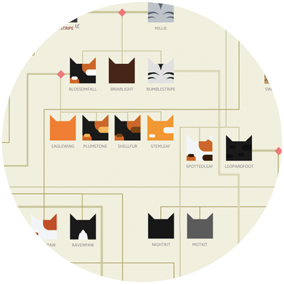
Working on Warriors was a joy and a privilege and a challenge, and I still count myself one of the luckiest people in the world to have been a part of its creation. But oh my goodness, I WISH I had made some family trees at the very beginning! I would be richer than my wildest dreams if I had a pound for every time I’ve been asked who Graystripe’s parents were, or Dustpelt’s, or Spottedleaf’s, or… The honest truth is that we didn’t give a moment’s thought to parents or littermates when I came up with the cast lists for the first series. We simply came up with a nice cat’s name whenever we needed a new character. We didn’t dream that these cats would exist beyond a single generation, into several lifetimes of stories. I thought I was breaking new ground by keeping a record of fur and eye colour! And look at the errors I made there, even though I promise I tried REALLY HARD to keep everything consistent.
I grew up with cats and kittens on the farm where I spent my childhood but I had no idea how genetically dependent fur and eye colours are, nor that tortoiseshell cats can’t be male or fertile (I suspect I still have that wrong!). You can imagine my dismay when Warriors became sufficiently popular to be discussed on internet forums and I came across pages and pages of readers who were utterly horrified that we’d created biologically impossible colour combinations within litters, and dismissed numerous laws of nature. I hold my hands up and admit that many of the mistakes were mine, and I just wanted a charming variety of colours in my imaginary Clans.
We took the cast list very seriously in terms of story-building, though. Right from the start, we wanted to have characters of all ages who would bring a wealth of different experiences and opinions to the busy social and political life of the Clans. One thing I hadn’t anticipated about writing a world populated by cats was that I wasn’t restricted to having central characters that reflected the age of my readers. Conventionally, in a book for readers in their early teens (for example), the characters at the centre of the story will be a similar age, perhaps a year or two older, so that readers can identify with them on an everyday level.
But cats age at a completely different rate to humans, so characters who had started off as cute little kits soon turned into teens (apprentices) and then adults (warriors) who could make significant decisions about love, loyalty and morality. Our central characters could basically get married and have children, which would be extraordinary in a children’s book featuring people. And oh, the freedom this gave us! Our hero’s best friend, Graystripe, is old enough to watch his mate die in childbirth by the end of Book Three. The wise and noble leader who welcomes Rusty into ThunderClan is an old, frail creature by Book Five, driven mad by suspicion and betrayal. The lessons the apprentices are taught about following the warrior code suddenly become a matter of life and death when they are old enough to defend the borders alone, and face enemies intent on destruction.
This was a rare and precious jewel in my story-building resources that I hadn’t understood at all when I first started thinking up characters, when I never imagined that anyone would be interested in each cat’s parents or siblings or cousins. It quickly became one of the series’ greatest strengths, something that I think accounts for the appeal Warriors has to readers of all ages.
But I still wish I had made family trees for the cast list of Book One.
Marvellous Maps
It is no secret that I am terrible at drawing. Those of you who have met me on tour will know that I offer to draw a small fat cat or a small fat sheep in your books if I am asked to provide an illustration. But I have always loved maps, and even now I still like to check the GPS (satellite navigation) in my car against a road atlas before I start a new journey. The first Warriors book was based on a very sketchy image of four territories divided top to bottom by a river and left to right by a road, and that was it. I think Highstones were stuck somewhere near the top margin, and I drew some boxes with roofs to indicate the town where Rusty came from.
As HarperCollins prepared to publish Book One, they made the fabulous decision to include a map on the first pages. Two maps, in fact: one for the cats and one from a human perspective. Joy! My world would be brought to life in front of my very eyes! Except these maps didn’t exist, and I was the only person who contained all the geographical knowledge inside my head.
So I took some enormous sheets of paper to a friend who is a real live artist, and together we went through each line of the manuscript for Book One adding every mention of a stream, a copse, a bend in the river, some notable rocks, to a huge, carpet-sized map. It was an epic afternoon, crawling around on our hands and knees, debating whether a stream that was mentioned in Chapter Two was the same stream twelve chapters further on, and where exactly the four giant oaks should be so that they were accessible to all the Clans. Coincidentally, my artist friend lives in Bournemouth, a large town on the English south coast very close to the New Forest. This is a glorious area of ancient woodland, parts of it open heath and other parts dense forest, full of legends and historical adventures. It is split horizontally by a massive main road, the A38, which gets clogged with tourist traffic every summer.
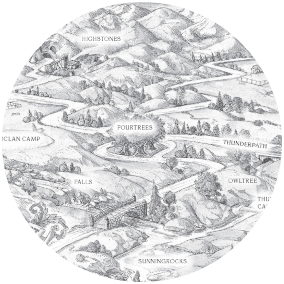
As we drew the giant map, I realised that my imaginings of the Clans’ territories had been inspired by the place I had visited many times for walks and inspiration. The cats lived in the New Forest! Admittedly a very stylised version – there is no dramatic river gorge in the real forest, the areas of woodland and open heath are not so clearly defined, and there isn’t a single large town where domestic kitties are terrorised by local rogues. But if I am asked, as I have been a thousand times, where the warriors lived, I always say the New Forest in Hampshire, England, because that’s where the first detailed map was created.
The floor-sized map was scaled down to a manageable size and sent to the official illustrator who created the two maps that fill the flyleaves of all the books set in the original territories. It gave me the biggest thrill ever to open the first edition of Into the Wild and see our fictional world in black and white. Yes, I thought. This is where the cats live.
I assumed my map-drawing days were over so it was something of a shock when we reached Series Two and I gaily suggested relocating the four Clans to a completely new set of territories. Another map was needed! This time I prepared the map at the very beginning of creating the stories, to avoid having to trawl through manuscripts looking for references to streams and notable clumps of bracken again. The lake isn’t based on anywhere at all, it is simply an amalgamation of beautiful scenery that I have admired in the past, together with a sense of where I would like to live. I have always loved water and mountains in close proximity – and I would absolutely love to discover a Moonpool and follow the steps of my ancestors into their sacred stone hollow. I was able to make the tail wag the dog, as it were, by anticipating future stories with my inclusion of the little island where the Clans would meet at full moon, and the crumbling wooden jetty on the opposite side of the lake. Giving ThunderClan a long-abandoned quarry for their camp felt full of possibility, too – though at that stage I couldn’t predict the astonishing cliff top stand-off between Squirrelflight and Ashfur in which she reveals the truth about her three children, and which remains my favourite scene I have ever created.
The original map I drew for Series Two is tucked away in storage somewhere, and would probably fetch a decent sum if I put it up for auction given that there are very few examples of original Vicky Holmes artwork in existence. I do remember being mocked for drawing little horses in one of the fields beside the lake which apparently looked like mutant dogs, and were queried by the official illustrator. How rude! Of course they were horses! They had long round noses and flowing tails! As for the original floor-sized map, that was put into the recycling box once it had been scaled down, which seems like a sad decision now. If I still had it, I would laminate it and use it on the floor of my study to remind myself how far the warriors and I have travelled.
Building a Religion
We always knew that the warrior cats would have some kind of semi-organised religion, a set of spiritual beliefs that made them even more different from domestic cats, and more mysterious. Venerating their ancestors through the stars made sense: if a warrior died a noble death, the remaining cats could easily look up into the night sky and claim that another star had appeared, looking down on them. We didn’t want a sense of a “God-cat”, a central figure responsible for everything in the world of the Clans. That would tread too close to existing religions. Instead we wanted a set of beliefs that could be based on universal principles of honour and respect – for yourself, for your Clanmates, and for the world around. The dead cats would watch over the living, but without being able to control them or shape their destiny too literally. The warriors needed to be able to make their own decisions, choose their own paths wherever they led.
The warrior code was pretty vague for the first series; like adding new characters, we basically created a rule whenever it seemed one was needed until we felt that we had covered all areas of Clan life. It wasn’t until I came to write CODE OF THE CLANS that I realised there were fourteen rules! I think I assumed there were about ten. At least there was an even number. It would have felt strange to write CODE about eleven rules, or seventeen, or nine. If I created an entire new world, I would come up with my rules at the beginning and use them to drive and inspire stories. But I don’t feel disappointed with how the warrior code turned out. Writing CODE OF THE CLANS was an absolute joy, not just because the shorter stories felt so much easier to construct than a 70,000 word epic, but also because I realised that we had created a sound and logical moral code for my beloved cats. The principles of cherishing young and old, respecting your enemy, being loyal to your community, all work in real life too. And I always wanted to show that the most important value of all was that of compassion, an ability to be kind even to those who don’t seem deserving.

Quite quickly, I asked if we could introduce the idea of a “good atheist” into the Clans: a cat who didn’t believe that they were being watched by sentient ancestors, who didn’t think that going to the Moonstone (or later, the Moonpool) gave them a direct line to the dead, and who had no expectations of going to StarClan themselves. In the first series, this was Cloudtail, Fireheart’s boisterous kittypet nephew who plunges headlong into Clan life and shows promise of being a great warrior, brave and loyal and hardworking, except that he doesn’t believe in StarClan. I deliberately made no moral judgement about this myself, and instead let Cloudtail’s other qualities speak for him.
In Series Two, I went one step further and created Mothwing to be an atheist medicine cat. I was fascinated to explore whether a cat could fulfil all the duties of the Clan’s spiritual leader without actually believing in StarClan or the possibilities of the Moonpool. Religion and spirituality are so important in today’s world even if we do not share the beliefs of others, and I felt it was my responsibility to explore different forms of belief and practice through my characters. Plus it led to some fantastic stories for Mothwing and her brother Hawkfrost!
Which seems a suitable note to end on: That in all the elements of the worlds you create, story is everything. Draw on your personal experiences and passions, explore the qualities you would like and dislike in other people, conjure the places you wish to visit. But above all else, create good stories to fit into your worlds. Harness those infinitely colourful fish, take your reader by the hand, and let adventures unfold.